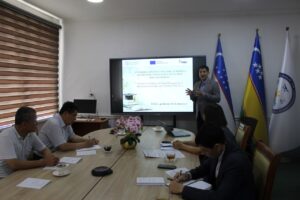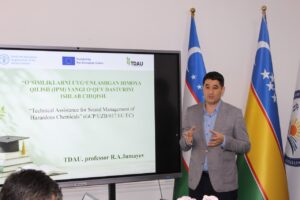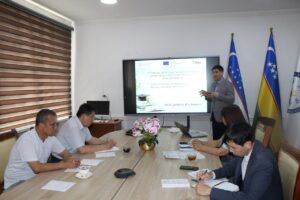
Jumayev Rasul Akhmatovich, Professor of the Department of Plant Protection and Quarantine at Tashkent State Agrarian University, on discussing the development of a new 3-year curriculum and training programs in the field of “Integrated Plant Protection (IPM) ” within the framework of the project “Technical Assistance for Sound Management of Hazardous Chemicals” (GCP/UZB/017/EC/EC), implemented jointly with Tashkent State Agrarian University and the Food and Agriculture Organization of the United Nations (FAO), submitting proposals and further cooperation.
Jumayev Rasul Akhmatovich, Professor of the Department of Plant Protection and Quarantine at Tashkent State Agrarian University. The speaker provided detailed information on the curricula, subject programs, and presentation materials for the “Integrated Plant Protection (IPM) ” direction, prepared within the framework of the “Technical Assistance for Sound Management of Hazardous Chemicals” (GCP/UZB/017/EC/EC) project, implemented jointly with Tashkent State Agrarian University and FAO, and submitted them for discussion.
Jumayev Rasul Akhmatovich, Professor of the Department of Plant Protection and Quarantine at Tashkent State Agrarian University, spoke and provided detailed information on the work being carried out within the framework of the project “Technical Assistance for Sound Management of Hazardous Chemicals” (GCP/UZB/017/EC/EC), implemented jointly with Tashkent State Agrarian University and the Food and Agriculture Organization of the United Nations (FAO).
He spoke about the main goals and objectives of the educational direction “Integrated Plant Protection (IPM) ” developed within the framework of the project, as well as the relevance of this direction today. In particular, the importance of the IPM system in ensuring environmental safety in agriculture, the rational use of chemicals, the widespread introduction of biological protection methods, and improving crop quality was emphasized.
The report also provided information on the content of curricula, subject programs, and syllabuses developed for the newly established 3-year educational direction. It was noted that foreign experience, international educational standards, and modern agricultural technologies were taken as a basis for developing curricula.
During the presentation, explanations were also provided regarding the content of specialized disciplines, practical classes, laboratory work, and industrial internships included in the program. Furthermore, it was noted that the introduction of this field of study will expand opportunities for training qualified specialists with modern knowledge. The meeting participants listened to the reports and presentation materials with interest and expressed their opinions and suggestions.