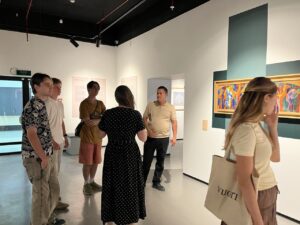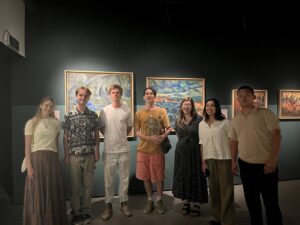
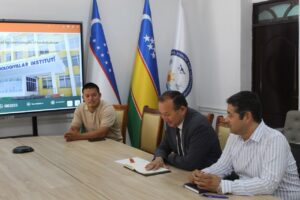
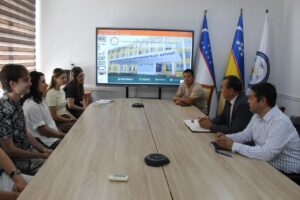
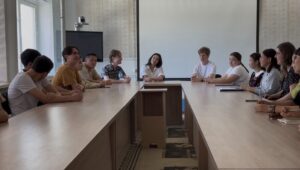
At the meeting, the rector and representatives of the institute’s leadership warmly welcomed the guests and provided detailed information about the history of the institute, its current activities, scientific potential, international cooperation, and educational directions. Students of Rhodes College received answers to their questions regarding the environmental problems of the Aral Sea region, scientific research on agricultural development, as well as environmental and social processes in the region. The meeting was held in a friendly and sincere atmosphere. The parties discussed the expansion of academic exchange programs, the implementation of joint scientific projects, and the development of international cooperation between students. During the visit, the guests also got acquainted with the Information Resource Center of the institute. This visit will serve to further strengthen cooperation between the two higher educational institutions and develop international educational cooperation.
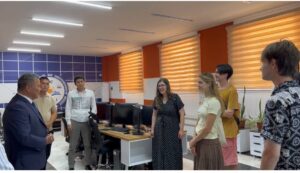
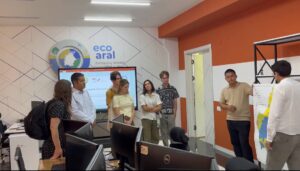
One of the most important parts of the visit was an excursion to the institute’s modern GIZ (Geographic Information Systems) center and scientific laboratories. During the excursion, the guests had the opportunity to get acquainted with scientific research in the fields of agriculture, agrotechnology and ecology.
Experts provided students and scientists of Rhodes College with detailed information about the importance of GIZ technologies in agriculture and natural resource management. They familiarized themselves with the processes of monitoring land resources, analyzing sown areas, effectively using water resources, and assessing the environmental situation using modern software. In particular, the use of GIZ technologies in monitoring and analyzing environmental changes occurring in the Aral Sea region aroused great interest among the guests.
During the meeting, students of the two higher educational institutions made presentations about their educational process, areas of specialization, research work and student life. The students exchanged views on the specifics of the educational process, practical classes, scientific projects, and future professional plans.
The meeting also continued in a Q&A format, where participants received answers to their questions on topics related to the higher education system in the USA and Uzbekistan, opportunities created for students, international exchange programs, scientific research, and campus life. This dialogue served to expand students’ horizons, familiarize them with foreign educational experience, and deepen their understanding of the importance of international cooperation.
Representatives of the Japan International Cooperation Agency (JICA) working at the institute, Marin and Yuna, also participated in the meeting. They spoke with students about their experience, educational cooperation between Uzbekistan and Japan, and their participation in international projects. Marin and Yuna advised students on learning foreign languages, actively participating in international programs, and effectively communicating with representatives of different cultures.
At the conclusion of the meeting, which was held in a sincere and friendly atmosphere, the students expressed a desire to continue mutual contacts and participate in future joint projects and academic exchange programs. This event played an important role in developing intercultural dialogue among youth, strengthening international friendship, and expanding cooperation in the fields of education and science.
The guests got acquainted with the unique historical, archaeological and cultural heritage preserved in this world-famous museum. Museum specialists provided them with detailed information about the rich history, ancient civilizations, national customs, and cultural heritage of Karakalpakstan.
During the excursion, students and scholars viewed ancient fortresses, historical monuments, and valuable exhibits discovered during archaeological excavations in the region with great interest. In particular, the guests were greatly impressed by the models, photographs, and scientific descriptions of the ancient fortresses in the Ellikkala area, as well as historical monuments such as Tuprakkala, Ayazkala, and Jonboskala. They also received interesting information about the role and significance of these monuments in the history of Central Asia.
In the ethnography department of the museum, guests familiarized themselves with the traditional lifestyle of the Karakalpak people, national costumes, handicrafts, and examples of folk applied arts. During the visit, information was also provided on the ongoing work to preserve the rich cultural heritage of Karakalpakstan and pass it on to future generations.
Representatives of Rhodes College highly praised the museum’s rich collection and unique exhibits, expressing satisfaction with the opportunity to get acquainted with the centuries-old history and culture of Karakalpakstan. This visit played an important role in strengthening cultural ties between the two peoples, increasing interest in studying historical heritage, and developing international cultural dialogue.