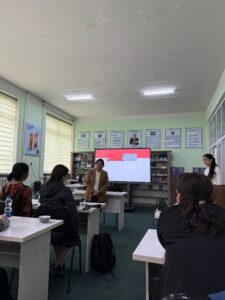
2026 On April 15, a seminar was held at the Karakalpak Institute of Agriculture and Agrotechnologies with participants of the Aral School educational course on the topic of accounting for the beneficial properties of food products within the framework of the Aral Sea region’s food system.
To the seminar (https://www.aralschool.uz/kk) Muhabbat Orinbayeva – specialist in public finance and sustainable development with a master’s degree in economics. He is interested in sustainable development, environmental restoration, community-based solutions, economic policy, environmental restoration, and projects linking education to the future of the Aral Sea region.
Ze-China was born in Northern China. A researcher and designer who studies the ecological history and cultural landscapes of arid lands.
Lyla Amini is an Afghan-American young specialist and practitioner whose work in Tajikistan focuses on climate-resilient agriculture and environmental protection, ancestral knowledge, ecology, and seed production.
Intizor Otaniyozova (Kazakhstan) is an artist who lives in Almaty, Central Asia, has a background in finance, and is currently interested in restoring her connection with nature.
On behalf of Karakalpakstan’s agriculture and agrotechnologies: Doctor of Agricultural Sciences, Professor Sultanova Zulfiya, Doctor of Agricultural Sciences, Professor Yusupov Risnazar, and 1st-year master’s students in the fields of storage and primary processing of agricultural products and technology of cultivation and processing of medicinal plants took an active part.
Professor Z. Sultanova presented the results of her scientific work to the seminar participants, sharing her thoughts and results on growing salt-tolerant halophyte plants, testing new lines and varieties of traditional and non-traditional plants resistant to stress factors, and their use in food. Participants expressed their interest in this matter and shared their opinions.
Doctor of Agricultural Sciences, Professor Risnazar Yusupov, introduced the cultivation of melons—one of the invaluable products on our people’s tables—from early-summer varieties to melon and watermelon varieties stored from autumn and winter to spring. In recent years, during the cultivation of these crops, a dangerous pest—the melon fly—has caused damage to melons and watermelons, and he presented the results of work on the spread, transmission, prevention of pests, and protection against them.
He showed great interest in the plants inherited from our region’s drought-resistant ancestors—sorghum, wheat, millet, and sesame—and expressed interest in expanding their use. Aziza Kutlimuratova, a 1st-year Master’s student in Agricultural Processing Technology, presented her scientific work on this issue, introducing her experience in preparing confectionery products from sorghum flour and presenting them for tasting. This sparked great interest among the guests, who also expressed interest in preparing many products and offering them to our people.
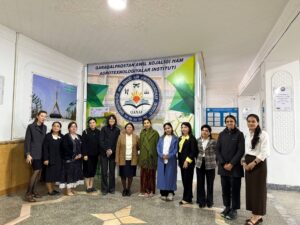
First of all, our guests. From left to right: Ze, Muhabbat Orinboeva, Lyla Amini, and Intizor Otaniyozova.